(note: some readers may find the LaTeX more readable on LessWrong.)
In this post I prove a variant of Gödel’s completeness theorem. My intention has been to really understand the theorem, so that I am not simply shuffling symbols around, but am actually understanding why it is true. I hope it is helpful for at least some other people.
For sources, I have myself relied mainly on Srivastava’s presentation. I have relied a lot on intuitions about sequent calculus; while I present a sequent calculus in this post, this is not a complete introduction to sequent calculus. I recommend Logitext as an online proof tool for gaining more intuition about sequent proofs. I am familiar with sequent calculus mainly through type theory.
First-order theories and models
A first-order theory consists of:
- A countable set of functions, which each have an arity, a non-negative integer.
- A countable set of predicates, which also have non-negative integer arities.
- A countable set of axioms, which are sentences in the theory.
Assume a countably infinite set of variables. A term consists of either a variable, or a function applied to a number of terms equal to its arity. An atomic sentence is a predicate applied to a number of terms equal to its arity. A sentence may be one of:
- an atomic sentence.
- a negated sentence,
.
- a conjunction of sentences,
.
- a universal,
, where x is a variable.
Define disjunctions (


So far this is fairly standard; see Peano arithmetic for an example of a first-order theory. I am omitting equality from first-order theories, as in general equality can be replaced with an equality predicate and axioms.
A term or sentence is said to be closed if it has no free variables (that is, variables which are not quantified over). A closed term or sentence can be interpreted without reference to variable assignments, similar to a variable-free expression in a programming language.
Let a constant be a function of arity zero. I will make the non-standard assumption that first-order theories have a countably infinite set of constants which do not appear in any axiom. This will help in defining inference rules and proving completeness. Generally it is not a problem to add a countably infinite set of constants to a first-order theory; it does not strengthen the theory (except in that it aids in proving universals, as defined below).
Before defining inference rules, I will define models. A model of a theory consists of a set (the domain of discourse), interpretations of the functions (as mapping finite lists of values in the domain to other values), and interpretations of predicates (as mapping finite lists of values in the domain to Booleans), which satisfies the axioms. Closed terms have straightforward interpretations in a model, as evaluating the expression (as if in a programming language). Closed sentences have straightforward truth values, e.g. the formula
Judgments and sequent rules
A judgment is of the form 


The inference rules are expressed as sequents. A sequent has one judgment on the bottom, and a finite set of judgments on top. Intuitively, it states that if all the judgments on top are provable, the rule yields a proof of the judgment on the bottom. Along the way, I will show that each rule is sound: if every judgment on the top is true in all models, then the judgment on the bottom is also true in all models. Note that the rules do not take into account axioms; we can add the axioms as assumptions on the left hand side later, to compensate.
In these rules, Γ, Δ, Σ, and Π represent countable sets of closed sentences, P and Q represent closed sentences, x represents a variable, c represents a constant, and t represents a closed term. 
![\phi[t] = \phi](https://s0.wp.com/latex.php?latex=%5Cphi%5Bt%5D+%3D+%5Cphi&bg=eeeeee&fg=666666&s=0&c=20201002)
![\phi[t]](https://s0.wp.com/latex.php?latex=%5Cphi%5Bt%5D&bg=eeeeee&fg=666666&s=0&c=20201002)
Assumption rule:

This states that if the same sentence appears on both sides, the judgment can be trivially proven. Clearly, in any model, P must be true or false, so either a sentence on the left is false or one on the right is true.
Cut rule:

Suppose the top two judgments are true in all models. Then in any model where all of Γ are true and all of Δ are false, P must be true, but it also must be false, a contradiction. So any model must have at least one of Γ false or at least one of Δ true, showing the conclusion. (Note that this cut rule is simplified relative to the usual presentation.)
Weakening rule:

Suppose the top judgment is true in all models. Then no model has all of Γ true and all of Δ false. So clearly the bottom judgment is true in all models.
Weakening simply let us remove sentences from either side. Most sequent calculi involve contraction rules, for “doubling” a given sentence, but this is unnecessary given our set-theoretic interpretation of both sides of a judgment.
Rules for compound sentences (negations, conjunctions, and universals) come in left and right varieties, to handle compounds on the left and right of judgments respectively.
Left negation rule:

Suppose the top judgment is true in all models. Then any model in which Γ are all true and Δ are all false has P true. So clearly, the bottom judgment must be true of all models.
Right negation rule:

Suppose the top judgment is true in all models. Then any model in which Γ are all true and Δ are all false has P false. So clearly, the bottom judgment must be true of all models.
Left conjunction rule:

Clearly, all of 

Right conjunction rule:
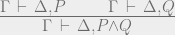
Suppose both top judgments are true in all models. Then in any model where Γ are all true and Δ are all false, P and Q must both be true. So the bottom judgment holds in all models.
Left universal rule:
![\frac{\Gamma, \phi[t] ~ \vdash ~ \Delta}{\Gamma, (\forall x, \phi[x]) ~ \vdash ~ \Delta}](https://s0.wp.com/latex.php?latex=%5Cfrac%7B%5CGamma%2C+%5Cphi%5Bt%5D+%7E+%5Cvdash+%7E+%5CDelta%7D%7B%5CGamma%2C+%28%5Cforall+x%2C+%5Cphi%5Bx%5D%29+%7E+%5Cvdash+%7E+%5CDelta%7D&bg=eeeeee&fg=666666&s=2&c=20201002)
Suppose the top judgment is true in all models. Then in any model where all of Γ are true and all of Δ are false, ![\forall x, \phi[x]](https://s0.wp.com/latex.php?latex=%5Cforall+x%2C+%5Cphi%5Bx%5D&bg=eeeeee&fg=666666&s=0&c=20201002)
Right universal rule:
![\frac{\Gamma ~ \vdash ~ \Delta, \phi[c]}{\Gamma ~ \vdash ~ \Delta, (\forall x, \phi[x])}](https://s0.wp.com/latex.php?latex=%5Cfrac%7B%5CGamma+%7E+%5Cvdash+%7E+%5CDelta%2C+%5Cphi%5Bc%5D%7D%7B%5CGamma+%7E+%5Cvdash+%7E+%5CDelta%2C+%28%5Cforall+x%2C+%5Cphi%5Bx%5D%29%7D&bg=eeeeee&fg=666666&s=2&c=20201002)
We require that the constant c does not appear in Γ, Δ, or ![\phi[x]](https://s0.wp.com/latex.php?latex=%5Cphi%5Bx%5D&bg=eeeeee&fg=666666&s=0&c=20201002)
![\phi[c]](https://s0.wp.com/latex.php?latex=%5Cphi%5Bc%5D&bg=eeeeee&fg=666666&s=0&c=20201002)
A proof of a judgment can be defined recursively: it selects a rule whose bottom is the judgment to be proven, and includes a proof of every judgment on the top. The proof tree must be finite for the proof to be valid.
To simplify future proofs, we will show derived sequent rules:
Right disjunction rule (derived):

This demonstrates how sequents can be composed. While we could move P and Q to the right side, this turns out to be unnecessary as the rule is used later.
Contradiction rule (derived):

This shows that a set of assumptions that implies a sentence and its negation is inconsistent. Note that either side of a judgment can be left empty to indicate an empty set of sentences.
Left double negation rule (derived):

Right double negation rule (derived):

Proving soundness
Gödel’s completeness theorem states that a closed sentence is provable in a first-order theory if and only if it is true in all models of the theory. This can be separated into a soundness lemma, stating that any provable sentence holds in all models of the theory, and a completeness lemma, stating that any sentence holding in all models of the theory is provable.
What I am showing here is Gödel’s completeness theorem for the variant of first-order logic presented. Specifically, if T is a first-order theory, let 

Let’s consider the soundness lemma, which states that if
Alternative statement of the completeness lemma
The completeness lemma states that any sentence holding in all models of the theory is provable. If the theory is T with axioms Θ, this states that for any sentence P, if P is true in all models of T, then
Let’s consider an alternative lemma, the model existence lemma, stating that if a theory is consistent (in that the judgment 
Suppose we have a theory T with axioms Θ, and P is true in all models of T. Construct the alternative theory T’ which is T with the additional axiom that 

We have shown that if P is true in all models of T, then it is provable in T. So if we prove the model existence lemma, the completeness lemma follows.
The Henkin construction
To make it easier to prove the model existence lemma, we will consider constructing an alternative Henkin theory for T. In a Henkin theory, for any sentence ![(\exists x, \phi[x]) \rightarrow \phi[c]](https://s0.wp.com/latex.php?latex=%28%5Cexists+x%2C+%5Cphi%5Bx%5D%29+%5Crightarrow+%5Cphi%5Bc%5D&bg=eeeeee&fg=666666&s=0&c=20201002)
![(\forall x, \neg \phi[x]) \vee \phi[c]](https://s0.wp.com/latex.php?latex=%28%5Cforall+x%2C+%5Cneg+%5Cphi%5Bx%5D%29+%5Cvee+%5Cphi%5Bc%5D&bg=eeeeee&fg=666666&s=0&c=20201002)
![\exists x, \phi[x]](https://s0.wp.com/latex.php?latex=%5Cexists+x%2C+%5Cphi%5Bx%5D&bg=eeeeee&fg=666666&s=0&c=20201002)
We wish to show that if T is a consistent theory, then there is a consistent Henkin theory whose axioms are a superset of T’s. Let us number in order the sentences with zero or one free variables as 


![\Theta_i := \Theta_{i-1}, (\forall x, \neg \phi[x]) \vee \phi[c_i]](https://s0.wp.com/latex.php?latex=%5CTheta_i+%3A%3D+%5CTheta_%7Bi-1%7D%2C+%28%5Cforall+x%2C+%5Cneg+%5Cphi%5Bx%5D%29+%5Cvee+%5Cphi%5Bc_i%5D+&bg=eeeeee&fg=666666&s=0&c=20201002)
We set each constant 

![\phi_i[x]](https://s0.wp.com/latex.php?latex=%5Cphi_i%5Bx%5D&bg=eeeeee&fg=666666&s=0&c=20201002)
Define each theory 


![\Theta_{i-1}, (\forall x, \neg \phi[x]) \vee \phi[c_i] \vdash](https://s0.wp.com/latex.php?latex=%5CTheta_%7Bi-1%7D%2C+%28%5Cforall+x%2C+%5Cneg+%5Cphi%5Bx%5D%29+%5Cvee+%5Cphi%5Bc_i%5D+%5Cvdash&bg=eeeeee&fg=666666&s=0&c=20201002)
Intuitively, if ![(\forall x, \neg \phi[x]) \vee \phi[c_i]](https://s0.wp.com/latex.php?latex=%28%5Cforall+x%2C+%5Cneg+%5Cphi%5Bx%5D%29+%5Cvee+%5Cphi%5Bc_i%5D&bg=eeeeee&fg=666666&s=0&c=20201002)
![\frac{\frac{\Theta_{i-1}, \neg (\forall x, \neg \phi[x]), \neg \phi[c_i] ~ \vdash ~ Q}{\Theta_{i-1} ~ \vdash ~ (\forall x, \neg \phi[x]) \vee \phi[c_i], Q} ~~~~~~ \frac{\Theta_{i-1}, (\forall x, \neg \phi[x]) \vee \phi[c_i] ~ \vdash}{\Theta_{i-1}, (\forall x, \neg \phi[x]) \vee \phi[c_i] ~ \vdash ~ Q}}{\Theta_{i-1} ~ \vdash ~ Q}](https://s0.wp.com/latex.php?latex=%5Cfrac%7B%5Cfrac%7B%5CTheta_%7Bi-1%7D%2C+%5Cneg+%28%5Cforall+x%2C+%5Cneg+%5Cphi%5Bx%5D%29%2C+%5Cneg+%5Cphi%5Bc_i%5D+%7E+%5Cvdash+%7E+Q%7D%7B%5CTheta_%7Bi-1%7D+%7E+%5Cvdash+%7E+%28%5Cforall+x%2C+%5Cneg+%5Cphi%5Bx%5D%29+%5Cvee+%5Cphi%5Bc_i%5D%2C+Q%7D+%7E%7E%7E%7E%7E%7E+%5Cfrac%7B%5CTheta_%7Bi-1%7D%2C+%28%5Cforall+x%2C+%5Cneg+%5Cphi%5Bx%5D%29+%5Cvee+%5Cphi%5Bc_i%5D+%7E+%5Cvdash%7D%7B%5CTheta_%7Bi-1%7D%2C+%28%5Cforall+x%2C+%5Cneg+%5Cphi%5Bx%5D%29+%5Cvee+%5Cphi%5Bc_i%5D+%7E+%5Cvdash+%7E+Q%7D%7D%7B%5CTheta_%7Bi-1%7D+%7E+%5Cvdash+%7E+Q%7D&bg=eeeeee&fg=666666&s=3&c=20201002)
We can set ![Q = \neg (\forall x, \neg \phi[x])](https://s0.wp.com/latex.php?latex=Q+%3D+%5Cneg+%28%5Cforall+x%2C+%5Cneg+%5Cphi%5Bx%5D%29&bg=eeeeee&fg=666666&s=0&c=20201002)
![\Theta_{i-1}, \neg (\forall x, \neg \phi[x]), \neg \phi[c_i] \vdash \neg (\forall x, \neg \phi[x])](https://s0.wp.com/latex.php?latex=%5CTheta_%7Bi-1%7D%2C+%5Cneg+%28%5Cforall+x%2C+%5Cneg+%5Cphi%5Bx%5D%29%2C+%5Cneg+%5Cphi%5Bc_i%5D+%5Cvdash+%5Cneg+%28%5Cforall+x%2C+%5Cneg+%5Cphi%5Bx%5D%29&bg=eeeeee&fg=666666&s=0&c=20201002)
![\Theta_{i-1} \vdash \neg (\forall x, \neg \phi[x])](https://s0.wp.com/latex.php?latex=%5CTheta_%7Bi-1%7D+%5Cvdash+%5Cneg+%28%5Cforall+x%2C+%5Cneg+%5Cphi%5Bx%5D%29&bg=eeeeee&fg=666666&s=0&c=20201002)
![\Theta_{i-1} \vdash \neg \phi[c_i]](https://s0.wp.com/latex.php?latex=%5CTheta_%7Bi-1%7D+%5Cvdash+%5Cneg+%5Cphi%5Bc_i%5D&bg=eeeeee&fg=666666&s=0&c=20201002)
![\Theta_{i-1} \vdash \forall x, \neg \phi[x]](https://s0.wp.com/latex.php?latex=%5CTheta_%7Bi-1%7D+%5Cvdash+%5Cforall+x%2C+%5Cneg+%5Cphi%5Bx%5D&bg=eeeeee&fg=666666&s=0&c=20201002)
So if 

Suppose we showed the model existence lemma for
Proving the model existence lemma for Henkin theories
Suppose T is a consistent Henkin theory. We wish to show that it has a model. This model will be a term model, meaning its domain of discourse is the set of closed terms. We need to assign a truth value to each closed sentence; number them as 
Let the axioms of T be Θ. Define 


Let 

By induction, each 
We must check that this putative model actually satisfies the axioms of 

For atomic P, this is trivial.
Negations
Consider 

Suppose first that Q is true in M. Then we have 
Suppose instead that Q is false in M. Then there is no proof of
Conjunctions
Consider 
Suppose first that both Q and R are true in M. Then both are provable in 
Suppose Q is false in M. Then there is no proof of

So P is false in M and not provable in
Suppose R is false in M. This is symmetric with Q.
Universals
Consider ![P = \forall x, \phi[x]](https://s0.wp.com/latex.php?latex=P+%3D+%5Cforall+x%2C+%5Cphi%5Bx%5D&bg=eeeeee&fg=666666&s=0&c=20201002)
![\Theta_\omega \vdash \phi[t]](https://s0.wp.com/latex.php?latex=%5CTheta_%5Comega+%5Cvdash+%5Cphi%5Bt%5D&bg=eeeeee&fg=666666&s=0&c=20201002)
Suppose that
![\frac{\frac{\frac{}{\Theta_\omega, \phi[t] ~ \vdash ~ \phi[t]}}{\Theta_\omega, (\forall x, \phi[x]) ~ \vdash ~ \phi[t]}~~~~~~ \frac{\Theta_\omega ~ \vdash ~ (\forall x, \phi[x])}{\Theta_\omega ~ \vdash ~ \phi[t], (\forall x, \phi[x])}}{\Theta_\omega ~ \vdash ~ \phi[t]}](https://s0.wp.com/latex.php?latex=%5Cfrac%7B%5Cfrac%7B%5Cfrac%7B%7D%7B%5CTheta_%5Comega%2C+%5Cphi%5Bt%5D+%7E+%5Cvdash+%7E+%5Cphi%5Bt%5D%7D%7D%7B%5CTheta_%5Comega%2C+%28%5Cforall+x%2C+%5Cphi%5Bx%5D%29+%7E+%5Cvdash+%7E+%5Cphi%5Bt%5D%7D%7E%7E%7E%7E%7E%7E+%5Cfrac%7B%5CTheta_%5Comega+%7E+%5Cvdash+%7E+%28%5Cforall+x%2C+%5Cphi%5Bx%5D%29%7D%7B%5CTheta_%5Comega+%7E+%5Cvdash+%7E+%5Cphi%5Bt%5D%2C+%28%5Cforall+x%2C+%5Cphi%5Bx%5D%29%7D%7D%7B%5CTheta_%5Comega+%7E+%5Cvdash+%7E+%5Cphi%5Bt%5D%7D&bg=eeeeee&fg=666666&s=3&c=20201002)
So P is false in M and not provable in
Suppose instead that each ![\Theta_\omega \vdash (\forall x, \neg \neg \phi[x]) \vee \neg \phi[c]](https://s0.wp.com/latex.php?latex=%5CTheta_%5Comega+%5Cvdash+%28%5Cforall+x%2C+%5Cneg+%5Cneg+%5Cphi%5Bx%5D%29+%5Cvee+%5Cneg+%5Cphi%5Bc%5D&bg=eeeeee&fg=666666&s=0&c=20201002)
![\Theta_\omega \vdash \phi[c]](https://s0.wp.com/latex.php?latex=%5CTheta_%5Comega+%5Cvdash+%5Cphi%5Bc%5D&bg=eeeeee&fg=666666&s=0&c=20201002)

Intuitively this says that if Q and 
![\Theta_\omega \vdash (\forall x, \neg \neg \phi[x])](https://s0.wp.com/latex.php?latex=%5CTheta_%5Comega+%5Cvdash+%28%5Cforall+x%2C+%5Cneg+%5Cneg+%5Cphi%5Bx%5D%29&bg=eeeeee&fg=666666&s=0&c=20201002)
![\Gamma = \Theta_\omega, P = (\forall x, \neg \neg \phi[x]), Q = \phi[c]](https://s0.wp.com/latex.php?latex=%5CGamma+%3D+%5CTheta_%5Comega%2C+P+%3D+%28%5Cforall+x%2C+%5Cneg+%5Cneg+%5Cphi%5Bx%5D%29%2C+Q+%3D+%5Cphi%5Bc%5D&bg=eeeeee&fg=666666&s=0&c=20201002)
![\frac{\frac{\frac{\frac{}{\phi[d] ~ \vdash ~ \phi[d]}}{\frac{\neg \neg \phi[d] ~ \vdash ~ \phi[d]}{(\forall x, \neg \neg \phi[x]) ~ \vdash ~ \phi[d]}}}{\frac{(\forall x, \neg \neg \phi[x]) ~ \vdash ~ (\forall x, \phi[x]))}{\Theta_\omega, (\forall x, \neg \neg \phi[x]) ~ \vdash ~ (\forall x, \phi[x])}}~~~~~~ \frac{\Theta_\omega ~ \vdash ~ (\forall x, \neg \neg \phi[x])}{\Theta_\omega ~ \vdash ~ (\forall x, \phi[x]), (\forall x, \neg \neg \phi[x])}}{\Theta_\omega ~ \vdash ~ (\forall x, \phi[x])}](https://s0.wp.com/latex.php?latex=%5Cfrac%7B%5Cfrac%7B%5Cfrac%7B%5Cfrac%7B%7D%7B%5Cphi%5Bd%5D+%7E+%5Cvdash+%7E+%5Cphi%5Bd%5D%7D%7D%7B%5Cfrac%7B%5Cneg+%5Cneg+%5Cphi%5Bd%5D+%7E+%5Cvdash+%7E+%5Cphi%5Bd%5D%7D%7B%28%5Cforall+x%2C+%5Cneg+%5Cneg+%5Cphi%5Bx%5D%29+%7E+%5Cvdash+%7E+%5Cphi%5Bd%5D%7D%7D%7D%7B%5Cfrac%7B%28%5Cforall+x%2C+%5Cneg+%5Cneg+%5Cphi%5Bx%5D%29+%7E+%5Cvdash+%7E+%28%5Cforall+x%2C+%5Cphi%5Bx%5D%29%29%7D%7B%5CTheta_%5Comega%2C+%28%5Cforall+x%2C+%5Cneg+%5Cneg+%5Cphi%5Bx%5D%29+%7E+%5Cvdash+%7E+%28%5Cforall+x%2C+%5Cphi%5Bx%5D%29%7D%7D%7E%7E%7E%7E%7E%7E+%5Cfrac%7B%5CTheta_%5Comega+%7E+%5Cvdash+%7E+%28%5Cforall+x%2C+%5Cneg+%5Cneg+%5Cphi%5Bx%5D%29%7D%7B%5CTheta_%5Comega+%7E+%5Cvdash+%7E+%28%5Cforall+x%2C+%5Cphi%5Bx%5D%29%2C+%28%5Cforall+x%2C+%5Cneg+%5Cneg+%5Cphi%5Bx%5D%29%7D%7D%7B%5CTheta_%5Comega+%7E+%5Cvdash+%7E+%28%5Cforall+x%2C+%5Cphi%5Bx%5D%29%7D+&bg=eeeeee&fg=666666&s=3&c=20201002)
So P is true and provable in
We have handled all cases by now. By induction, every closed sentence is true in M if and only if it is provable in
Conclusion
Let’s summarize the argument. We start with a first-order theory T and a proposition P. Since the sequent rules are sound, if T proves P, then P is true in all models of T. Suppose instead that T does not prove P. Then we create a modification of T with the additional axiom that
If we wish to have equality in the theory, we introduce an equality predicate and axioms. The model will give truth values for the equality predicate (saying which terms are equal), and assign truth values to predicates in a way consistent with the equalities. It is now possible to construct equivalence classes of terms according to the equality predicate, to get a proper model of a first-order theory with equality. (I have skipped presenting the details of this construction.)
While it is non-standard to prove a universal
I have previously shown that a consistent guessing oracle can create a propositional model (as in an assignment of truth values to sentences consistent with axioms) of a consistent first-order theory. While I have not shown it in this post, under some additional assumptions, I believe it is possible to create a first-order model of a first-order theory (without equality) using a consistent guessing oracle if the axioms of the theory are recursively enumerable. This is because the step of extending the Henkin theory to a complete theory can be done with a consistent guessing oracle, as with propositional models of first-order theories.
My current understanding of sequent calculus is that, other than the structural rules of cut and weakening and the left universal rule, all rules of sequent calculus are complete in addition to being sound, in that if a judgment is provable, it is provable by first applying the rule and then proving its top judgments (assuming the rule applies at all). The cut and weakening rules are relatively unproblematic, as cut and weakening can in general be eliminated. The left universal rule has two problems: it might need to be used more than once on the same universal, and it requires instantiating the universal with a specific term, whereas the domain of discourse may have elements that cannot be written as terms. The Henkin construction largely handles the second problem.
Studying Henkin theories may be illuminating for understanding non-standard models of first-order theories such as Peano Arithmetic and ZFC. The Henkin construction means there is a constant satisfying any predicate
 statement in the
  for each Turing machine encoding N, representing the oracle’s answer about this machine.
 for each possible state s of the Turing machine, where the state includes the head state and the state of the tape, representing that s is reached by the machine’s execution.
 .
. .
. .
. .
. ,
,  .
. be the execution trace of M when given the oracle represented by the
  must be true in the model, using axiom schemas (d) and (e). Since
  is true in the model and
  is a final state, H must also be true in the model due to the axiom schema (c). This is a contradiction.
 be the (infinite) execution trace of M on this oracle. We set
  for some i, and none of these states are final.
 .
. Unstable Ontology